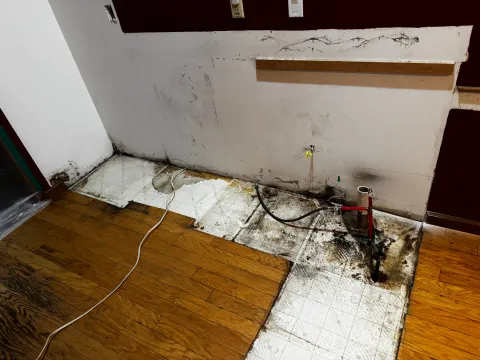
Limited; professional remediation recommended for areas larger than 10 sq ft or involving structural/hidden mold.
Mold remediation projects often involve health hazards, potential structural compromise, specialized containment, and adherence to specific health and building codes. Professional assessment and execution are frequently required to ensure effective and safe resolution, particularly in DuPage County where environmental conditions can exacerbate mold growth.
Project Guidelines & Rules
Initial Assessment and Scope Definition
2 Rules
Qualified professional assessment recommended for areas exceeding 10 sq ft.
Industry Best Practice, often implied by health guidelines
Identification of moisture source is critical.
Fundamental Remediation Principle, prerequisite for IRC/Plumbing Code compliance for repairs
Permitting and Code Compliance
4 Rules
Consult with your local municipality for specific permit requirements related to demolition, structural repairs, electrical work, or plumbing modifications.
Local Jurisdiction Requirement
Structural repairs exceeding minor cosmetic work may require building permits and inspections.
2024 IRC R105.1, R105.2
Electrical system alterations or repairs must comply with the 2023 NEC and require permits and inspections.
2023 NEC 80.29, 2024 IRC E106.1
Plumbing system alterations or repairs must comply with the Illinois Plumbing Code and require permits and inspections.
Illinois Plumbing Code 890.110, 2024 IRC P2501.1
Health, Safety, and Containment Protocols
3 Rules
Establish appropriate containment barriers to prevent cross-contamination to unaffected areas, particularly for medium to large projects.
Industry Best Practice, IHRP-5 Guidance
Ensure adequate personal protective equipment (PPE) is utilized by all workers.
OSHA 1926.1101, General Safety Protocol
Maintain negative air pressure within containment areas using HEPA-filtered air scrubbers.
Industry Best Practice, IICRC S520 Guidance
Moisture Source Elimination
5 Rules
All active leaks or sources of moisture ingress must be repaired in accordance with the Illinois Plumbing Code for plumbing systems.
Illinois Plumbing Code 890, 2024 IRC P2501.1
Building envelope deficiencies (e.g., roof leaks, foundation cracks, flashing issues) contributing to moisture must be addressed as per 2024 IRC requirements.
2024 IRC R703, R905, R401
Ensure proper grading away from foundation to prevent water intrusion, maintaining a minimum 5% slope for 10 feet where possible.
2024 IRC R401.3
Maintain crawl spaces and basements free of standing water and ensure proper ventilation as per 2024 IRC R408.3 and R408.4.
2024 IRC R408.3, R408.4
Exterior foundation drainage systems (e.g., drain tile) must be designed and installed to a minimum 42-inch frost depth for DuPage County conditions, where applicable for new construction or substantial renovation.
2024 IRC R403.1.4.1 and DuPage County Regional Standards
Affected Material Removal and Cleaning
3 Rules
Porous materials with mold growth that cannot be effectively cleaned (e.g., drywall, insulation, carpeting) must be removed and properly disposed of.
Industry Best Practice, IICRC S520
Non-porous surfaces with mold growth must be thoroughly cleaned using appropriate biocide or detergent solutions and dried.
Industry Best Practice, IICRC S520
Ensure structural wood members are free of significant mold growth and structurally sound. Replacement or repair must conform to 2024 IRC structural provisions (e.g., R502, R602).
2024 IRC Chapter 5, Chapter 6
Drying and Post-Remediation Environment
2 Rules
Achieve and maintain indoor relative humidity below 60% and material moisture content levels consistent with healthy building standards (e.g., wood moisture content below 16%) prior to reconstruction.
Industry Best Practice, IICRC S520, ASHRAE 160
Ensure proper attic ventilation (IRC R806) and general dwelling unit ventilation (IRC M1507) to prevent future moisture accumulation.
2024 IRC R806, M1507
Reconstruction and Final Inspection
5 Rules
All reconstruction and repairs must comply with the 2024 IRC, 2023 NEC, and Illinois Plumbing Code.
2024 IRC R101.3, 2023 NEC 90.2, Illinois Plumbing Code 890.110
Electrical components damaged by moisture or mold must be replaced or repaired by a qualified electrician in accordance with 2023 NEC standards.
2023 NEC 110.12, 110.13(B), 2024 IRC E3402.2
Plumbing components damaged by moisture or mold must be replaced or repaired by a licensed plumber in accordance with Illinois Plumbing Code standards.
Illinois Plumbing Code 890.140, 2024 IRC P2501.1
Ensure proper installation of vapor retarders and insulation as per 2024 IRC Chapter 7 and Chapter 11 requirements to mitigate future moisture issues.
2024 IRC R702.7, R1102.1.2
Final inspections, as required by your local municipality, must be successfully completed.
Local Jurisdiction Requirement, 2024 IRC R109.1
Post-Remediation Verification
2 Rules
Consider third-party post-remediation verification (PRV) testing to confirm successful remediation, especially for larger or sensitive projects.
Industry Best Practice, IICRC S520
Ensure the absence of odors and visible mold growth in remediated areas.
Industry Best Practice, Visual Inspection
Top Rated Mold Remediation Pros in Lake County